

Key Highlights
• The AI in digital marketing lecture (PDF deck)
• Outline of planned AI modules for Emory’s Digital Marketing Certificate
• Reflection on how AI will reshape learning
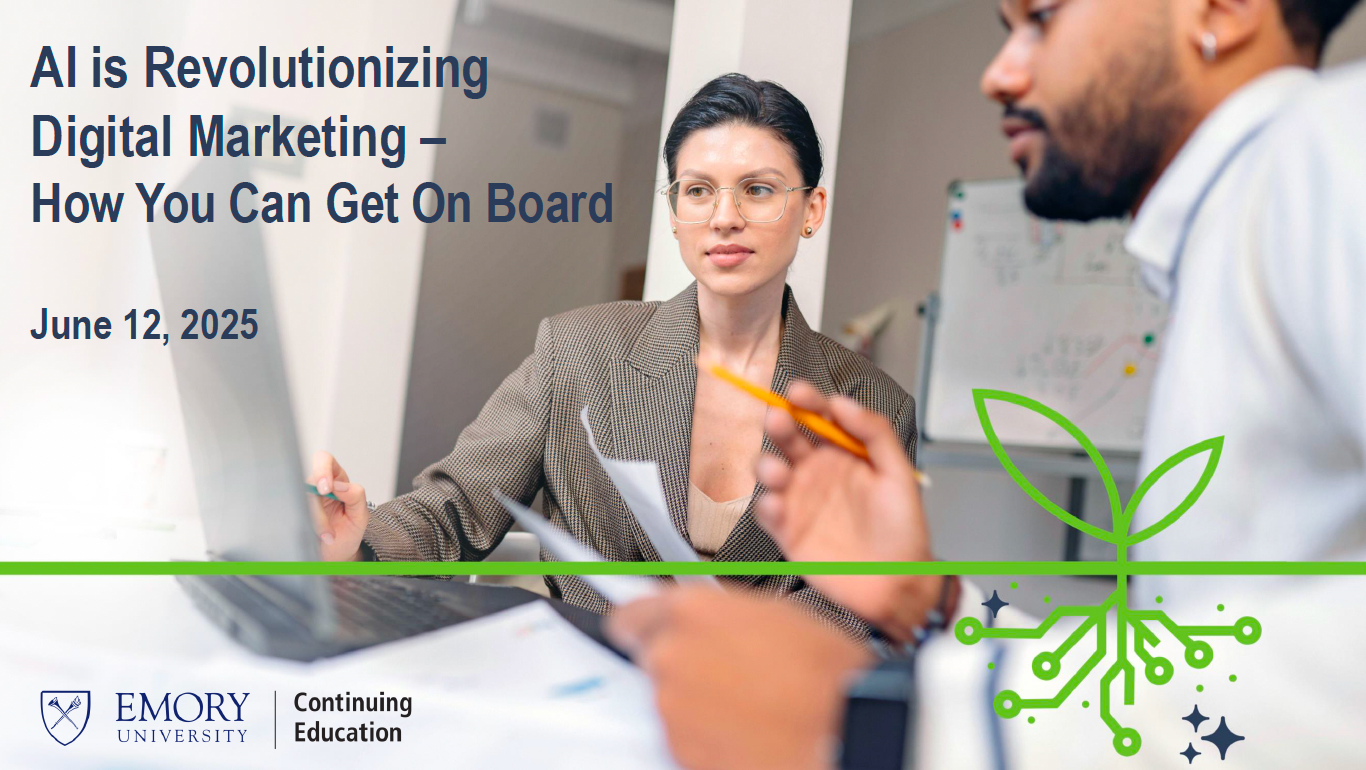
AI in digital marketing lecture at Emory University
I delivered "AI is Revolutionizing Digital Marketing — How You Can Get On Board" as part of Emory's public Lecture Series to several hundred students online in June 2025. I created the lecture to target marketers who are preparing to compete for opportunities in the field in the next few years. The hour-long lecture focused on three parts:
• Why? – Centaur Teams
• How? – AI and Digital Marketing
• What's Next? – Positioning
I opened the lecture with a discussion of how the Centaur Model plays out in marketing as it unleashes marketers toward human strengths like creativity, critical thinking, and decision-making, while AI handles tasks like data processing and pattern recognition. This synergism improves efficiency, accuracy, and overall productivity through optimization and testing, task automation, enhanced creativity, improved decision-making, and continuous learning and improvement. I then covered how AI is being practically integrated in digital marketing and illustrated that through several case studies of major brands successfully employing Centaur Teams in their marketing workflow. I ended the lecture with a pathway for how marketers can prepare to compete for these roles in the field.
• How? – AI and Digital Marketing
• What's Next? – Positioning
I opened the lecture with a discussion of how the Centaur Model plays out in marketing as it unleashes marketers toward human strengths like creativity, critical thinking, and decision-making, while AI handles tasks like data processing and pattern recognition. This synergism improves efficiency, accuracy, and overall productivity through optimization and testing, task automation, enhanced creativity, improved decision-making, and continuous learning and improvement. I then covered how AI is being practically integrated in digital marketing and illustrated that through several case studies of major brands successfully employing Centaur Teams in their marketing workflow. I ended the lecture with a pathway for how marketers can prepare to compete for these roles in the field.

Outline of planned AI modules for Emory’s Digital Marketing Certificate
I created and teach Emory's Digital Marketing: Build and Launch Better Multichannel Campaigns Certificate, which I evolved from our earlier versions dating back to 2012 when a colleague and I founded the original program. I am now growing the new program to include two new breakthrough modules on how AI is being used in digital marketing.
Outline of changes
Certificate rename: Digital Marketing: Campaign Planning Using AI
The existing name, Digital Marketing: Build and Launch Better Multichannel Campaigns, very much still defines what makes the program powerful. It’s workflow is even more aligned now with real-world experiences researching, planning, developing, launching, then running a live campaign using a real client capstone practicum. The new name: Digital Marketing: Campaign Planning Using AI keeps what’s best of the existing program’s brand, shortens it a bit, and adds in this exciting AI feature. The program's Digital Badge will also be updated to reflect the new name and will likely include an AI graphic addition.
The two new AI modules:
The AI sections, "Using AI in Digital Marketing," situated in weeks 8 and 9 of the program and prior to final capstone project delivery, serves two functions:
1. It adds a new, significant, and bold area of study for the certificate; and
2. It can act as a standalone workshop, where additional students may attend and interact with the content without having access to the rest of the program but work within the Canvas LMS.
1. It adds a new, significant, and bold area of study for the certificate; and
2. It can act as a standalone workshop, where additional students may attend and interact with the content without having access to the rest of the program but work within the Canvas LMS.
Unique section workshop:
For the Digital Marketing Certificate students, weeks 8 and 9, the AI sections, will complete the Module work prior to capstone. These two final weeks in the track are able to stand alone without consequence to the certificate students while serving as a unique section in the Canvas LMS for the workshop: "Using AI in Digital Marketing."
The workshop students can:
1. begin on week 8 and conclude their work after the end of week 9;
2. successfully complete all work and quizzes related to these two weeks;
3. interact with the full compliment of students in the cohort
4. then receive a digital badge for successful completion of the workshop.
1. begin on week 8 and conclude their work after the end of week 9;
2. successfully complete all work and quizzes related to these two weeks;
3. interact with the full compliment of students in the cohort
4. then receive a digital badge for successful completion of the workshop.
How this works:
This two-week section flows seamlessly with the rest of the program for certificate students. It includes required discussion assignments, which will add interest for the certificate students as they interact with the workshop students. There is a quiz at the end of each week for all students, and so for the workshop students upon successful completion they can be awarded a “Using AI in Digital Marketing” digital workshop badge.
Within the program in the Canvas LMS there are two modules that are sectioned off in the Canvas LMS only for workshop students, which is a duplicate of the week 8 and 9 material for certificate students. So, certificate students cannot see these two workshop modules, and workshop students cannot see the certificate material. However, they essentially appear the same when viewing the instructor's screen during live classes, sharing discussion assignments, and completing the quizzes.
'Using AI in Digital Marketing I and II" detail:
This new AI sections will seamlessly work to round-out the certificate’s Module 3: Campaign Execution and Management. The lesson plan for the AI sections include:
Week 8 -
Focus: Using AI in Digital Marketing I
Outcome: Understanding How AI Supports Marketing Tasks
Lecture: “How is AI Used in Marketing, Including Ethics and Privacy Issues”
Focus: Using AI in Digital Marketing I
Outcome: Understanding How AI Supports Marketing Tasks
Lecture: “How is AI Used in Marketing, Including Ethics and Privacy Issues”
Opening lecture covers:
1. Core AI concepts like machine learning, natural language processing, and computer vision in a summation of big picture theory.
2. Common skills used in AI-driven digital marketing
3. How having these skills positively impact a career
4. Pros and cons of AI in digital marketing practice
3. Ethical considerations and data privacy
2. Common skills used in AI-driven digital marketing
3. How having these skills positively impact a career
4. Pros and cons of AI in digital marketing practice
3. Ethical considerations and data privacy
>> Discussion Assignment follows lecture.
New Self-Study Assignments:
1. How is AI used in digital marketing?
2. Examples of AI in digital marketing
(visual examples with recent brand case studies)
3. How to use AI in digital marketing:
- Content and image creation
- Customer segmentations
- Customer service and support
- SEO/keyword research and content optimization
- PPC/ad targeting and analysis
- Data and predictive analytics
- Email marketing
- Personalized campaigns
1. How is AI used in digital marketing?
2. Examples of AI in digital marketing
(visual examples with recent brand case studies)
3. How to use AI in digital marketing:
- Content and image creation
- Customer segmentations
- Customer service and support
- SEO/keyword research and content optimization
- PPC/ad targeting and analysis
- Data and predictive analytics
- Email marketing
- Personalized campaigns
>> Quiz follows.
Week 9 -
Focus: Using AI in Digital Marketing II
Outcome: Experience with the Primary AI Apps Used by Marketers
Lecture: “Automation and AI in Digital Marketing”
Focus: Using AI in Digital Marketing II
Outcome: Experience with the Primary AI Apps Used by Marketers
Lecture: “Automation and AI in Digital Marketing”
Opening lecture covers:
1. Automation in digital marketing (use of software to perform routine marketing tasks). This enables real-time data analysis, personalized customer targeting/content, dynamic campaign adjustments, chatbots and VAs, programmatic advertising, and predictive insights.
2. Illustrating examples such as dynamic email marketing, social media listening and responding, recommendation engines based on user behavior, real-time ad optimization.
1. Automation in digital marketing (use of software to perform routine marketing tasks). This enables real-time data analysis, personalized customer targeting/content, dynamic campaign adjustments, chatbots and VAs, programmatic advertising, and predictive insights.
2. Illustrating examples such as dynamic email marketing, social media listening and responding, recommendation engines based on user behavior, real-time ad optimization.
>> Discussion Assignment follows lecture.
New Self-Study Assignments:
1. AI app demos, explanations, and guided practice for:
- automation for marketing workflows
- AI-based marketing customer data platform
- enhancing lead generation and customer interaction
- improving customer experiences in real-time
- on-page optimization
- AI writing assistance
- Generative AI, to convert natural language prompts to images
- NLP interactive customer experience, response on social
- social media management
- predictive email campaigning
- data visualization for analysis/insights
1. AI app demos, explanations, and guided practice for:
- automation for marketing workflows
- AI-based marketing customer data platform
- enhancing lead generation and customer interaction
- improving customer experiences in real-time
- on-page optimization
- AI writing assistance
- Generative AI, to convert natural language prompts to images
- NLP interactive customer experience, response on social
- social media management
- predictive email campaigning
- data visualization for analysis/insights
>> Quiz follows.
How AI will reshape learning
As I addressed in my June lecture for Emory's Lecture Series, the Centaur Model is the core foundation for how AI will reshape learning. AI is not merely an assistant agent, it's a key partner providing a strategic component alongside human intuition, strategic thinking, ethical considerations, ingenuity, empathy, and creativity. It releases the human in the partnership to be more, to reach new heights. This partnership leverages AI's computational power, data analysis, predictive capabilities, and constant learning to achieve an evolution in all sectors, especially learning.
AI is transforming the educational landscape, shifting away from a one-size-fits-all model towards a future characterized by personalization, efficiency, and enhanced engagement. In the Centaur team, the partnership in education works for the educator and instructional and experience designer, but also for the learner in a wide variety of ways:
1. Personalized, individualized learning experiences through adaptive learning paths, tailored content delivery, and intelligent tutoring systems.
2. Streamlined administrative tasks thanks to automated grading and feedback, personalized lesson planning, and streamlined administrative processes.
3. Enhanced student engagement and motivation through interactive and gamified content, virtual assistants and chatbots, and immersive learning experiences like virtual reality (VR) and augmented reality (AR).
4. Addressing diverse learning needs by using accessibility features and language learning support.
However, there are challenges and considerations we all must work through during this evolutionary path in learning. This includes bias and equity. Addressing this requires diverse data sets and careful monitoring to ensure fair and equitable outcomes. Privacy and data security remain an ongoing concern. However, robust data protection and clear policies will help safeguard sensitive information. And the digital divide remains uneven across the globe for access to AI tools and technology, which can widen existing educational inequalities.
With the extraordinary advancements that AI is already delivering to learning, human interaction via human educators remains essential for effective lifelong learning. While AI enhances learning, it cannot replace the human connection, mentorship, and emotional intelligence that educators bring to the classroom.
In conclusion
AI is poised to significantly reshape learning and education, offering powerful tools to personalize learning, streamline tasks, and enhance engagement. However, responsible implementation and addressing challenges related to bias, privacy, and human interaction are crucial to ensuring that AI benefits all learners and creates a more equitable and effective learning environment.